

Can Riverlane’s Deltaflow unlock useful quantum computing?, read on Quantum Zeitgeist
Image © Quantum Zeitgeist


Independent · open data · every fact sourced
Who does what in the UK's quantum sector: 138 companies and start-ups, 28 universities, the national labs and funders, and 70 projects linking them, from 9 national hubs to the NQCC testbeds. Each project links to its partners and its sources.
Latest news UK quantum companies UK quantum start-ups National hubs The sector at a glance
From Quantum Zeitgeist, linked to the organisations and projects each article names.
Image © Quantum Zeitgeist

Image © Quantum Zeitgeist

Image © Quantum Zeitgeist

Image © Quantum Zeitgeist
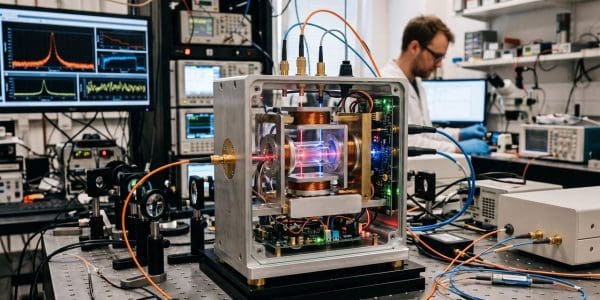
Image © Quantum Zeitgeist

Image © Quantum Zeitgeist
University-led consortia running 2024 to 2029, with £111.7m of EPSRC and UKRI grants between them. 4 earlier hubs have finished.
Q-BIOMED
A national research hub that develops quantum sensors for earlier diagnosis of disease. UCL and the University of Cambridge lead it.
Led by University College London
Funding: £24m
Themes: Sensing, Biomedical and health, Imaging
QuSIT
A national research hub for quantum sensing, imaging and timing, led by the University of Birmingham.
Led by University of Birmingham
Funding: £22m
Themes: Sensing, Imaging, Timing and navigation
QCi3
The national research hub for quantum computing, led by the University of Oxford. It works on scalable and networked quantum computers.
Led by University of Oxford
Funding: £21.9m
Themes: Computing, Networks, Software and algorithms
QEPNT
A national research hub for quantum position, navigation and timing, led by the University of Glasgow. It aims to reduce reliance on satellite signals such as GPS.
Led by University of Glasgow
Funding: £21.9m
Themes: Timing and navigation, Sensing, Defence and security
IQN
A national research hub building quantum networks, from local links to satellite connections. Heriot-Watt University leads it.
Led by Heriot-Watt University
Funding: £21.9m
Themes: Networks, Communications
Computing has the most projects (43), then sensing (23) and communications (17).
43 projects · 48 organisations
23 projects · 28 organisations
9 projects · 4 organisations
12 projects · 2 organisations
17 projects · 35 organisations
14 projects · 6 organisations
15 projects · 41 organisations
6 projects · 52 organisations
7 projects · 11 organisations
4 projects · 4 organisations
3 projects · 3 organisations
London has 67 organisations, South East 38 and Scotland 23.
Answers worked out from the directory's data when the site was last built.
This directory lists 138 UK quantum companies and start-ups among 213 organisations, which also include 28 universities, 15 national labs and research organisations, 11 government bodies and funders, and 12 investors. It covers organisations with a public profile we can source, so it is not a complete census.
They are multi-year research consortia, led by universities with industry partners, funded by Engineering and Physical Sciences Research Council, UK Research and Innovation and National Institute for Health and Care Research. 5 are active: QCi3 (University of Oxford), IQN (Heriot-Watt University), QEPNT (University of Glasgow), Q-BIOMED (University College London) and QuSIT (University of Birmingham). 4 earlier hubs have finished.
Project-level figures that a source states add up to £733.3m across 25 of the 70 projects listed. The largest is ISCF Commercialising Quantum Technologies Challenge at £174m. This is not a full account of UK public spending on quantum, since many projects have no published project-level figure.
London has 67 of the 211 organisations with a location (32%), followed by South East (38), Scotland (23) and East of England (20). By city, the most companies are in London (41), Cambridge (12), Glasgow (11) and Oxford (8).
Every project lists the public sources for its facts, such as UKRI grant records and official announcements. Company profiles come from Entangled Future and news from Quantum Zeitgeist. All 213 organisations and 70 projects can be downloaded as CSV or JSON and reused with credit.
Strategy, missions, funding commitments and hubs, with sources.
Computing leads with 43 projects; 10 more charts.
£733.3m across 25 projects with a sourced figure.
213 organisations and 70 projects as CSV or JSON.