Active Programme · 2025 onwards
EPSRC Quantum Technology Career Acceleration Fellowships
EPSRC fellowships for 11 early-career quantum technology researchers at UK universities.
Role: Partner
Themes: Skills and training, Computing, Sensing

University · Coventry
Warwick gathered its quantum researchers from physics, chemistry, computer science, mathematics, engineering and WMG into Warwick Quantum, launched in July 2025. Staff contribute to three of the five national hubs: diamond-based sensing for Q-BIOMED, Animesh Datta's work for QCi3, and Gavin Morley's for IQN. Semiconductor materials are another strand; in July 2026 Maksym Myronov and NRC Canada proposed quantum phononic links, in which vibrations in a semiconductor chip would carry quantum information between distant qubits.
University of Warwick, in Coventry, appears in six UK quantum projects listed here. It is a partner in 6 UK projects, including EPSRC Quantum Technology Career Acceleration Fellowships, QCi3 and IQN.
Sources: Warwick Quantum | University of Warwick · Warwick Quantum launch event | M4QN · Warwick researchers build quantum bus in push for 1M qubits | Quantum Zeitgeist
EPSRC fellowships for 11 early-career quantum technology researchers at UK universities.
Role: Partner
Themes: Skills and training, Computing, Sensing
QCi3
The national research hub for quantum computing, led by the University of Oxford. It works on scalable and networked quantum computers.
Role: Partner
Funding: £21.9m
Themes: Computing, Networks, Software and algorithms
IQN
A national research hub building quantum networks, from local links to satellite connections. Heriot-Watt University leads it.
Role: Partner
Funding: £21.9m
Themes: Networks, Communications
Q-BIOMED
A national research hub that develops quantum sensors for earlier diagnosis of disease. UCL and the University of Cambridge lead it.
Role: Partner
Funding: £24m
Themes: Sensing, Biomedical and health, Imaging
A BT-led consortium testing free-space quantum key distribution for short and mid-range links, including 5G and connected vehicles.
Role: Partner
Themes: Communications, Networks
QCS
The phase 2 national hub for quantum computing and simulation, led by the University of Oxford. It ran from 2019 to 2024.
Role: Partner
Funding: £27.3m
Themes: Computing, Software and algorithms
Recent articles from Quantum Zeitgeist that mention University of Warwick.

The team’s work offers compelling evidence for underlying connections between seemingly disparate areas of physics; specifically chaotic systems governed by deterministic rules and disordered ones described through random matrices promise new insights into complex behaviour. However, the researchers
Image © Quantum Zeitgeist
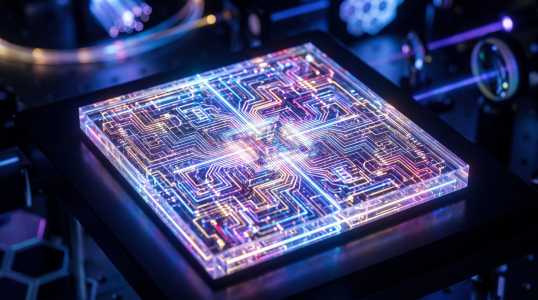
Warwick researchers developed Quantum Phononic Links (QPLs) using compressively strained germanium on silicon, cs-GoS, to connect qubits across a 300mm chip.
Image © Quantum Zeitgeist

Quantum accreditation of circuits previously demanded all two-qubit gates be of the Clifford type, potentially increasing circuit depth by a factor of four. New protocols now extend accreditation to circuits utilising non-Clifford gates, such as those natively implemented on current quantum hardware
Image © Quantum Zeitgeist

Constraints on spontaneous collapse models are typically limited by sensitivity to environmental noise. However, detecting subtle changes in the motion of two nanospheres offers a new approach, improving upon existing bounds by several orders of magnitude for realistic experimental parameters. This
Image © Quantum Zeitgeist
News from Quantum Zeitgeist.
Logos and names are trademarks of their respective owners, used to identify them. No endorsement implied.