
UK Quantum Technology Hub in Sensing, Imaging and Timing
QuSIT
A national research hub for quantum sensing, imaging and timing, led by the University of Birmingham.
Role: Lead
Funding: £22m
Themes: Sensing, Imaging, Timing and navigation

University · Birmingham
The University of Birmingham leads QuSIT, the national hub for quantum sensing, imaging and timing, with a £22.0m EPSRC grant for 2024 to 2029 and Michael Holynski as principal investigator. It also led the earlier UK Quantum Technology Hub in Sensors and Timing from 2019. Holynski's team located a buried tunnel with a quantum gravity gradiometer, reported in Nature in 2022 as the first such find outside a laboratory. Current hub work includes a Birmingham-led trial, supported by BAE Systems, that feeds Infleqtion's Tiqker quantum clocks into the ADRAN radar testbed.
University of Birmingham, in Birmingham, appears in six UK quantum projects listed here. In this directory it leads QuSIT and UK Quantum Technology Hub in Sensors and Timing and is a partner in 4 more. People profiled here include Michael Holynski (PI) and Simon Bennett (Executive Director).
Sources: EP/Z533166/1 QuSIT Hub | UKRI Gateway to Research · EP/T001046/1 UK Quantum Technology Hub in Sensors and Timing | UKRI Gateway to Research · Quantum gravity gradient sensor used outdoors to find tunnel | Physics World · QuSIT to boost UK quantum sensing and imaging projects with £774k grant | Quantum Zeitgeist
QuSIT
A national research hub for quantum sensing, imaging and timing, led by the University of Birmingham.
Role: Lead
Funding: £22m
Themes: Sensing, Imaging, Timing and navigation
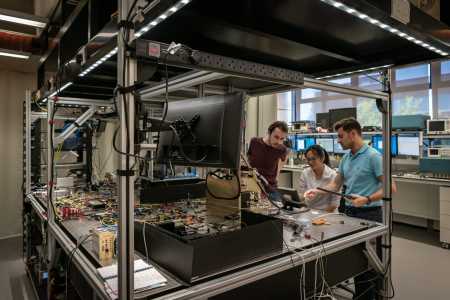
The phase 2 national hub for quantum sensors and clocks, led by the University of Birmingham. It ran from 2019 to 2024.
Role: Lead
Funding: £28.6m
Themes: Sensing, Timing and navigation
EPSRC fellowships for 11 early-career quantum technology researchers at UK universities.
Role: Partner
Themes: Skills and training, Computing, Sensing
QCNDS
A centre of excellence launched by AWE in November 2025 and led by the University of Strathclyde, applying quantum sensing and computing to nuclear science for national security.
Role: Partner
Themes: Computing, Sensing, Defence and security
NTC
An NPL-led programme to build a network of atomic clocks so that the UK relies less on satellite timing signals.
Role: Partner
Funding: £36m
Themes: Timing and navigation
Gravity Pioneer
An RSK-led consortium that built and tested a cold-atom gravity sensor for surveying what lies underground.
Role: Partner
Funding: £6m
Themes: Sensing
Recent articles from Quantum Zeitgeist that mention University of Birmingham.
The University of Birmingham & EPRI’s £2.63 million FURESHMA program will test advanced boride & carbide shielding materials, vital for durable fusion reactor components.
Image © Quantum Zeitgeist
The UK Quantum Technology Research Hub in Sensing, Imaging and Timing (QuSIT) has completed the application and grant-awarding phase of the QuSIT Accelerating Capability Fund (ACF) grant, allocating a total of £774k across multiple projects. This ACF Grant, funded by the Engineering and Physical Sci
Image © Quantum Zeitgeist
University of Illinois & Birmingham researchers experimentally realized a tuneable non-Abelian gauge field, using oscillators to create a local pseudo-spin and engineer couplings via real-time feedback.
Image © Quantum Zeitgeist
Calculating Imaginary-Time Evolution (ITE), essential for preparing quantum states and overcoming computational limitations, has traditionally demanded extra resources or risked inaccurate results. Now, a new approach sidesteps these issues by deriving ITE from standard measurements of real-time beh
Image © Quantum Zeitgeist
Research, commercial and investment relationships, by year. Partners with a profile here are linked.
BAE Systems Quantum Research 2021
Recorded on BAE Systems Quantum's profile.
News from Quantum Zeitgeist.
Logos and names are trademarks of their respective owners, used to identify them. No endorsement implied.