

Fraunhofer Centre for Applied Photonics
Research organisation · Glasgow
Glasgow's Fraunhofer centre for applied photonics, which led the QT Assemble consortium on compact quantum components and won £8m from DSIT in 2025.
Fraunhofer's first UK research centre, in Glasgow, with a dedicated unit for lasers and photonics used in quantum technologies.
This page covers the programme's funding and partners. The main page is the Fraunhofer Centre for Applied Photonics profile.
Project data last updated 11 October 2026
Fraunhofer CAP was set up in Glasgow in 2012 and is based at the University of Strathclyde's Technology and Innovation Centre. A dedicated quantum technologies business unit was reported in November 2021, when quantum work made up half of the centre's workload.
In December 2025 the centre received £8m from the Department for Science, Innovation and Technology for four years of work on photonics and quantum technologies. It led the QT Assemble project under the Quantum Technologies Challenge.
Research organisation · Glasgow
Glasgow's Fraunhofer centre for applied photonics, which led the QT Assemble consortium on compact quantum components and won £8m from DSIT in 2025.

University · Glasgow
Government · London
Quantum Zeitgeist articles about Fraunhofer CAP, then ones naming its lead or partners.

A collaborative project in the UK, backed by £1.5 million in funding from Innovate UK, is set to revolutionize the landscape of quantum key distribution (QKD) by developing and demonstrating high-fidelity, modular, and scalable receiver modules. The MARCONI project aims to introduce two new OEM QKD
Image © Quantum Zeitgeist
A significant milestone has been reached in the development of quantum technology, with Infleqtion and Thorlabs announcing a new partnership to commercialize Infleqtion’s highly integrated optical fiber collimation package. This breakthrough is expected to accelerate innovation in quantum applicatio
Image © Quantum Zeitgeist
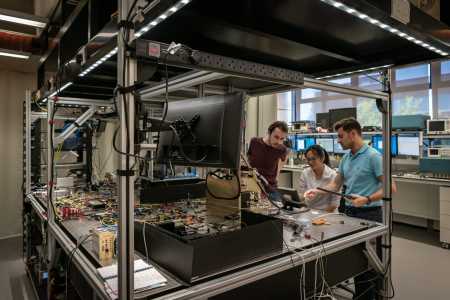
The UK Quantum Technology Research Hub in Sensing, Imaging and Timing (QuSIT) has completed the application and grant-awarding phase of the QuSIT Accelerating Capability Fund (ACF) grant, allocating a total of £774k across multiple projects. This ACF Grant, funded by the Engineering and Physical Sci
Image © Quantum Zeitgeist

A decoy-state quantum key distribution scheme was implemented using a telecom C-band single-emitter source, enabling positive secret key rates over 227 km of optical fiber. This demonstrates a loss tolerance one order of magnitude greater than non-decoy schemes, broadening the scope of single-photon
Image © Quantum Zeitgeist
QFoundry
A consortium led by the Compound Semiconductor Centre in Cardiff to set up an open-access foundry for quantum semiconductor components.
Led by Compound Semiconductor Centre
Themes: Materials and components, Communications, Sensing
QTIC
A University of Bristol innovation centre with facilities and support for quantum and deep tech start-ups.
Led by University of Bristol
Funding: £35m
Themes: Computing, Communications, Sensing
QMI
NPL's institute that provides measurement expertise and facilities for testing and validating quantum technologies.
Led by NPL
Themes: Timing and navigation, Sensing, Computing, Communications