
QPINN: Quantum Physics Informed Neural Networks for Derivative Pricing
OQC and Citi tested whether quantum-compressed neural networks can price financial derivatives.
Project data last updated 11 October 2026
About this project
Oxford Quantum Circuits led the project with Citi, the Quantum Software Lab and the NQCC. The team used quantum circuits to compress layers of physics-informed neural networks used to price derivatives.
OQC reported that a key layer needed far fewer parameters while pricing stayed broadly close to a classical model in many test cases. The work was part of the NQCC SparQ proof of concept projects for 2025-26.
Who leads it
Lead organisation

Oxford Quantum Circuits
Company · Reading
Reading-based maker of superconducting quantum computers (Toshiko, GENESIS), backed by a £260m Series C in June 2026.
Partners (3)

Citi
Company · London

Quantum Software Lab
Research organisation · Edinburgh

NQCC
Research organisation · Harwell
Funders
-
NQCC
Research organisation · Harwell
In the news
Quantum Zeitgeist articles naming the lead organisation or partners. They may not be about this project.

A recap of the Quantum Software Lab’s Quantum Fringe in Edinburgh, read on Quantum Zeitgeist
The Quantum Software Lab (QSL) at the University of Edinburgh has become a globally recognized hub for creating software solutions, and with its strategic partnership with the UK’s National Quantum Computing Centre (NQCC), now has more than 70 researchers. In three years, the QSL is poised to lead a
Image © Quantum Zeitgeist

University of Edinburgh’s Quantum Fringe festival builds on 1,000 attendees, read on Quantum Zeitgeist
Quantum Fringe Festival 2026, a two-month programme of events, explores the latest developments in quantum computing and its real-world applications. Building on last year’s event, which brought together around 1,000 attendees across 16 events, the festival running from May to July 2026, continues t
Image © Quantum Zeitgeist

Bristol and NQCC launch intensive quantum computing courses, read on Quantum Zeitgeist
The NQCC and University of Bristol offer two intensive, six-week online programs in quantum information and computation, ideal for STEM professionals.
Image © Quantum Zeitgeist
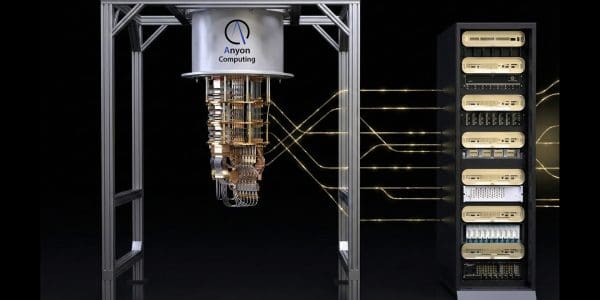
Anyon Computing links quantum processors to GPUs with NVIDIA tech, read on Quantum Zeitgeist
Anyon Computing unveiled a new open quantum control system built on NVIDIA NVQLink, designed so its microwave quantum control cluster and quantum processors join GPU and CPU compute nodes as co-processor nodes of a single supercomputing machine. The system will be open-sourced and serve as the contr
Image © Quantum Zeitgeist
Sources
- NQCC: Quantum Physics Informed Neural Networks for Derivative Pricing (nqcc.ac.uk)
- NQCC: Collaborative R&D (SparQ proof of concept projects) (nqcc.ac.uk)
- OQC: Exploring quantum AI for financial modelling (oqc.tech)
- Quantum Zeitgeist: OQC, Citi and NQCC find quantum-AI cuts data needs for finance (quantumzeitgeist.com)
Related projects
- Active Programme · 2026 onwards
Quantum Advantage TurboCHarger
QATCH
A four-year programme on quantum software, algorithms and verification, led by the University of Edinburgh's Quantum Software Lab with the NQCC.
Led by Quantum Software Lab
Funding: £20m
Themes: Computing, Software and algorithms
- Active Hub · 2024 to 2029
Hub for Quantum Computing via Integrated and Interconnected Implementations
QCi3
The national research hub for quantum computing, led by the University of Oxford. It works on scalable and networked quantum computers.
Led by University of Oxford
Funding: £21.9m
Themes: Computing, Networks, Software and algorithms
- Active Mission · 2023 to 2035
Quantum Mission 1: Quantum computing
Mission 1
A government goal that by 2035 there will be accessible, UK-based quantum computers able to run one trillion operations.
Led by Department for Science, Innovation and Technology
Themes: Computing, Software and algorithms